Most people start a family tree with good intentions and abandon it within weeks.
Not because they do not care, but because many trees feel like paperwork. You add names, birthdays, and locations, then wonder why none of it feels alive.
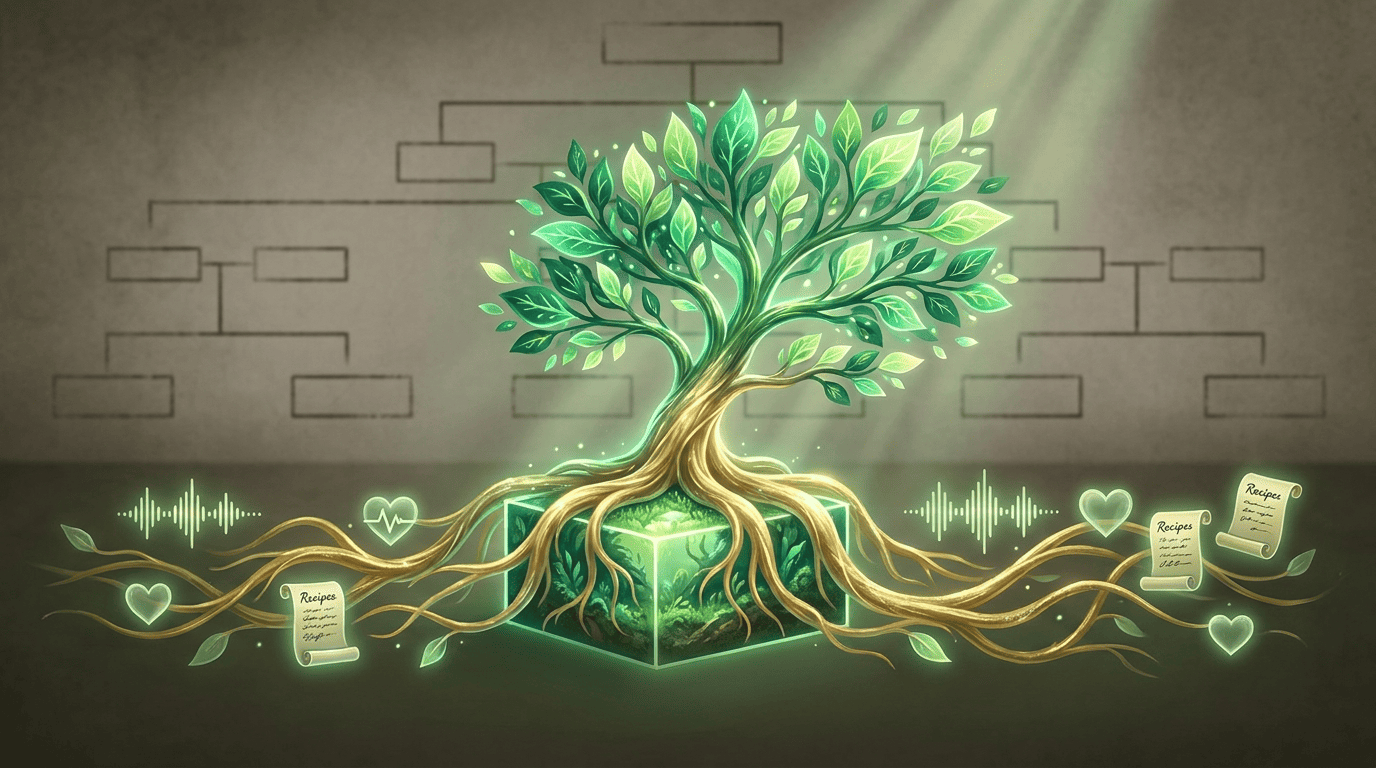
A useful family tree does more than prove relationships. It preserves identity. This guide shows how to build one that future generations can understand, not just inherit.
Why traditional family trees often fail families
The classic tree format is good at structure and weak at meaning.
It tells you that two people were related. It does not tell you whether they were close, estranged, resilient, generous, or complicated. It documents lineage, not life.
That is why many descendants say, "I have the tree, but I still do not know these people."
The living-tree model: what to capture for each person
Use the five-layer profile below for every key relative.
1. Identity basics
Include the essentials:
- full name and common nickname,
- birth and death details,
- places lived,
- languages spoken.
2. Story layer
Add at least one narrative for each person:
- a formative event,
- a hard decision,
- a moment of courage,
- a family legend with context.
3. Voice and media layer
Prioritize human texture:
- short voice clips,
- annotated photos,
- handwritten notes,
- video snippets of routines or rituals.
4. Relationship meaning layer
Capture social roles beyond biology:
- mentor,
- peacemaker,
- storyteller,
- financial anchor,
- caregiver.
5. Inheritance layer
Document what they intentionally passed on:
- values,
- skills,
- recipes,
- advice,
- letters.
When these layers are present, a profile becomes useful to people who never met the person.
A practical build order for busy families
Do not try to complete the whole tree at once.
- Start with one branch (10 to 20 people max).
- Complete basic identity fields first.
- Add one story per person.
- Attach one media artifact per person.
- Add relationship-meaning tags.
- Review monthly with relatives.
This phased approach reduces drop-off and creates visible progress quickly.
10 questions that improve tree quality fast
Use these during calls or visits:
- Which ancestor changed the direction of this family?
- What was the hardest period this person survived?
- What did this person believe strongly about?
- Which family rule started with this person?
- Which place mattered most to them, and why?
- What did they do when they were under pressure?
- What did younger people learn from them directly?
- What would they want remembered accurately?
- What misunderstanding about them should be corrected?
- Which object or tradition represents them best?
Common errors and how to avoid them
- Error: Adding too many distant relatives too early. Fix: Depth before breadth.
- Error: Uploading photos without labels. Fix: Add date, people, place, and one sentence of context.
- Error: Conflicting versions of events with no notes. Fix: Keep both versions and cite who shared each one.
- Error: Making one person the permanent admin. Fix: Use shared stewardship and backup roles.
What makes a family tree future-proof
A future-proof tree is:
- readable by non-experts,
- portable across platforms,
- backed up in more than one location,
- maintained by multiple generations.
If your descendants need special software and tribal knowledge to understand the archive, it will decay.
Next step: upgrade one profile today
Pick one grandparent profile and add:
- one 60-second voice note,
- one story with date context,
- one annotated photo,
- one value they tried to pass on.
Do this once and you will immediately feel the difference between a record and a legacy.
Read next
Keep reading
25 Family Traditions to Start This Year
A practical list of 25 family traditions you can start this year to build connection, preserve stories, and create lasting memories across generations.

How to Preserve Family Stories Before They Are Lost: A Practical Guide
A step-by-step guide to preserving family stories through voice, notes, and photos so future generations inherit people, not just files.

50 Questions to Ask Your Grandparents Before It's Too Late
Use these 50 thoughtful questions to ask grandparents and preserve family stories, values, and life lessons in their own words.
Join the conversation
Comments are powered by GitHub Discussions via Giscus. You'll need a free GitHub account to post.